
New · Final Project Report
Building the ApacheAI Mini Data Center
Flip through the book to see how three TJC classes built a business management and private AI data center.
Website Disclaimer
This is not an official website of Tyler Junior College (TJC). It is maintained by CNIT students for educational and informational purposes. It showcases projects, coursework, and accomplishments of students in TJC’s Computer & Networking Information Technology (CNIT) Department, shared with their permission. The content and views here do not necessarily reflect those of Tyler Junior College, and TJC’s name is used only to identify where the work was completed.
TJC Computer & Networking Information Technology
Real infrastructure.
Built by students.
Apache CNIT showcases what CNIT students at Tyler Junior College design, build and run. This year’s capstone is the Apache Mini-Data Center, inspired by Tyler Vault Datacenter and brought to life by three courses working as one team.

How it comes together
Three courses. One data center. Three certifications.
The courses run at the same time and hand work to each other like a relay. Each class owns a layer, and each is built around a CompTIA certification.

ITSC-1325 · COMPTIA A+
PC Hardware
Students rack the servers, install GPUs, check power and cooling, and document every machine before it goes into service.

ITNW-1358 · COMPTIA NETWORK+
Network+
Students build the edge firewall, VLANs and switching, stand up security monitoring, and run the AI servers students chat with.

ITNW-1309 · COMPTIA CLOUD+
Cloud Computing
Students install the services on top: Active Directory, DNS, dashboards, and the ERP, CRM and help desk a business runs on.
Partnership · Tyler Vault Datacenter
Where the datacenter becomes the classroom
An idea from a Tyler Area Chamber of Commerce technology meeting is now a working partnership, featured in the Tyler Morning Telegraph.
 In the NewsTyler Vault Datacenter: Where the Datacenter Becomes the ClassroomRead the Tyler Morning Telegraph story →
Tyler Vault Datacenter is setting aside dedicated, isolated server racks inside its operating datacenter for Tyler Junior College CNIT students. Students will design, install, configure and run real enterprise equipment without putting customer systems at risk. The first student cohort is expected in Spring 2027.
Tyler Vault also hopes to bring UT Tyler and Tyler ISD into the program.
Asked about hosting a CNIT class, Tyler Vault CEO Tommy Martin’s answer was simple: “Absolutely. How else are they going to learn?”
Local businesses are invited to contribute surplus or retired equipment and the time of experienced IT professionals. Inspired by that vision, TJC CNIT students are already building the skills it calls for in the Apache Mini-Data Center.
Student Projects
What CNIT students built
Hardware, Networking and Cloud Computing students at Tyler Junior College work together on real infrastructure: racked, cabled, secured and running.
ApacheAI Mini Data Center
Three courses run at the same time and hand off to each other like a relay to build one working data center. The Hardware class racks and prepares the servers, the Networking class builds the firewall, switching and security, and the Cloud class installs the services that run on top. The finished build serves a private AI chatbot and business applications to anyone on the lab Wi-Fi.
- ITSC-1325 PC Hardware
- ITNW-1358 Networking
- ITNW-1309 Cloud Computing
- Domainapacheai.local · Windows Server on every host
- VLAN 10Management & monitoring
- VLAN 20Production servers
- VLAN 30Student access
- VLAN 40DMZ, reserved, default deny
- HostsThanos · Hera · Eros · Orion · Zeus · Athena · Mercury
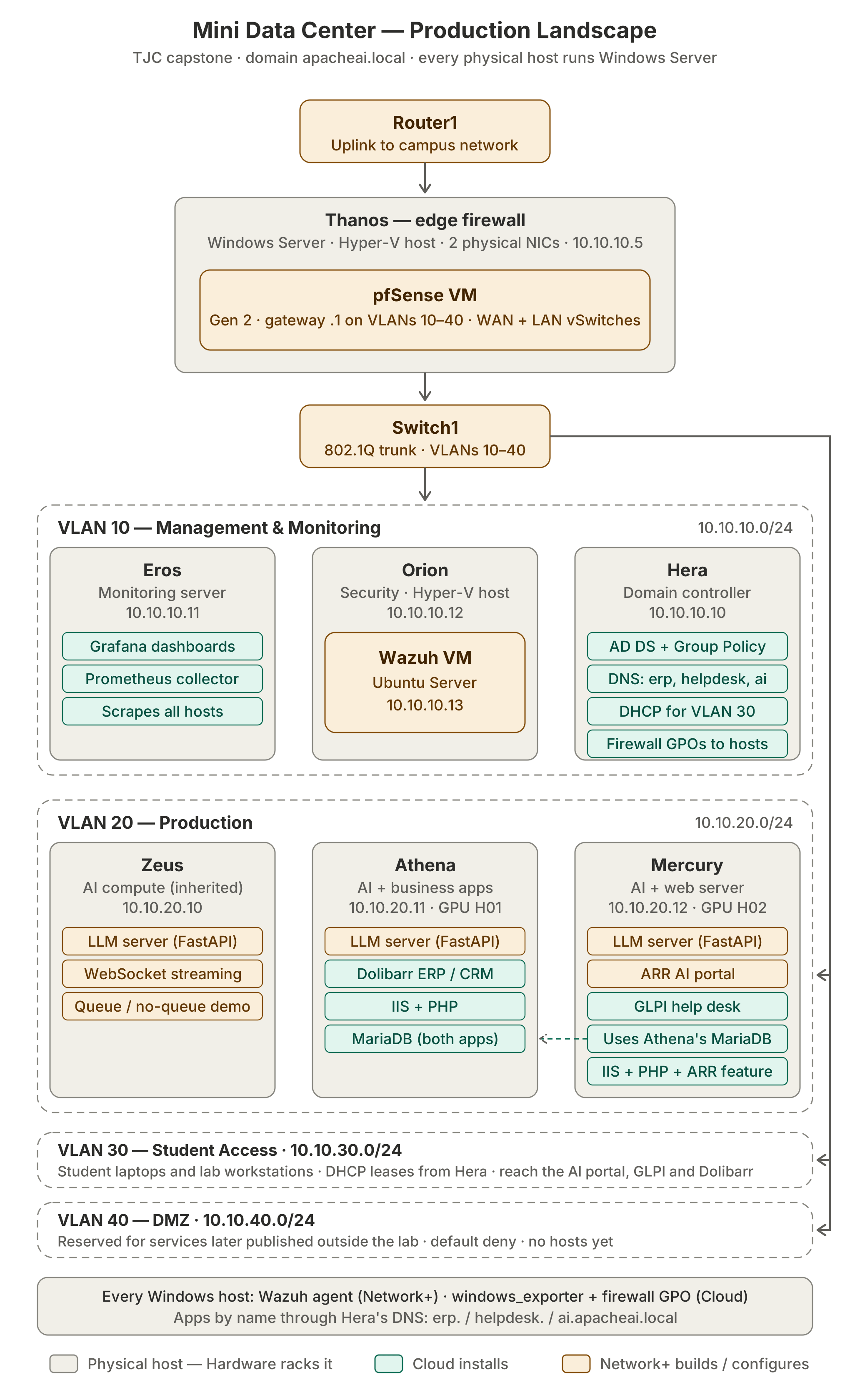 View the full network topology →
Live from the lab
Three AI servers, one dashboard
Every chat request is load-balanced across Zeus, Athena and Mercury. The dashboard students built shows each server's work in real time, right down to the packets on the wire.

- Three-server stripRunning jobs, tokens per second and GPU temperature for Zeus, Athena and Mercury.
- Real OSI layersThe latest request traced from HTTP down to MAC addresses and the physical link.
- Health over timeGPU temperature, throughput and running jobs across all servers for the last 15 minutes.
- Queue vs. no queueA switch that compares throughput and out-of-memory errors in each mode.
Captured after 36 jobs. Student names on the leaderboard are blurred.
Open full size →Load-Balanced Private AI
Three GPU servers, Zeus, Athena and Mercury, each run their own language model service. Chat requests are spread across all three, so no single server gets overloaded and every prompt stays on campus. Zeus was built by an earlier Networking class and is still in service.
Business Applications
Students deploy the multiuser software a small business runs on: an ERP and CRM, an IT help desk with asset inventory, and a shared database. Users reach each one by a friendly name like erp. or helpdesk. instead of an IP address.
Security in Layers
An edge firewall runs as a virtual machine on Hyper-V. VLANs keep guests, students and servers apart, and Active Directory and Group Policy manage every host. A security monitoring platform collects events from every Windows server.
Monitoring & Observability
A dedicated monitoring server collects health readings from every host and turns them into live dashboards, so students can see CPU, memory and service status across the whole data center at a glance.
Earlier projects
Small-Office Network Build
Students designed, configured and deployed the network devices and services for a small organization: server access, PCs, wireless connectivity, UPS backup, a shared printer and internet access. Each team member had a defined role, and the finished equipment was racked with a patch panel, switch, wireless router, KVM console, UPS and servers.
Hybrid Cloud Case Study
Acting as the consulting firm Apache Consulting, the cloud team worked a scenario for CSE, a fictional multi-location company. They recommended moving its on-premises servers to Azure, built a cloud server on an Azure virtual machine with Bastion for secure access, and used Azure File Sync to replicate files between the cloud and on-site servers.
Private AI Cloud on a Dell R720
The project that came before the mini data center: a single Dell PowerEdge R720 turned into a private AI cloud. Hardware owned the physical layer, Networking the logical layer and Cloud the service layer, with all AI compute kept local.
 Completed · Networking
AI Server Dashboard & OSI Model
A live dashboard for the class AI server that shows each student's prompt traveling through all seven OSI layers, from HTTP and WebSockets down to Ethernet frames and Cat6 signaling. It tracks GPU memory, temperatures, bandwidth, a prompt leaderboard and an event log, and a queue / no-queue switch lets students compare throughput and out-of-memory errors when jobs run one at a time versus all at once.



Why it matters
What students take with them
Real projects
Students build systems people actually use, not throwaway lab exercises, and they show them off at the end of the semester.
Hands-on experience
Racking servers, configuring VLANs, hardening hosts and running services, with the problems that only show up on real equipment.
Teamwork across courses
Each class depends on the others, so students learn to hand off work, write documentation and troubleshoot together.
Industry tools
Windows Server, Hyper-V, pfSense, Wazuh, Grafana and open-source business software: the same tools employers run.
Get involved
There's a place for you here

Employers
Looking for interns or new graduates who have already built and run real infrastructure? Come see their work.
- Attend the semester showcase
- Offer internships
- Review student projects

Community partners
Local organizations can help students learn by sharing what real IT work looks like.
- Speak to a class
- Donate used equipment
- Suggest a project

Future students
Want to build things like this? The CNIT program at Tyler Junior College is where it starts.
- PC Hardware (ITSC-1325)
- Network+ (ITNW-1358)
- Cloud Computing (ITNW-1309)